A few weeks ago, I wrote about why building your own Physical AI platform is much harder than it first appears. The next question I wanted to tackle was -
"What exactly does Xemelgo do with all of that sensor data?"
The answer has very little to do with RFID.
It has everything to do with how warehouses and factories have always worked.
Long before sensors existed, warehouses and factories already had intelligence built into them. It just happened to be human.
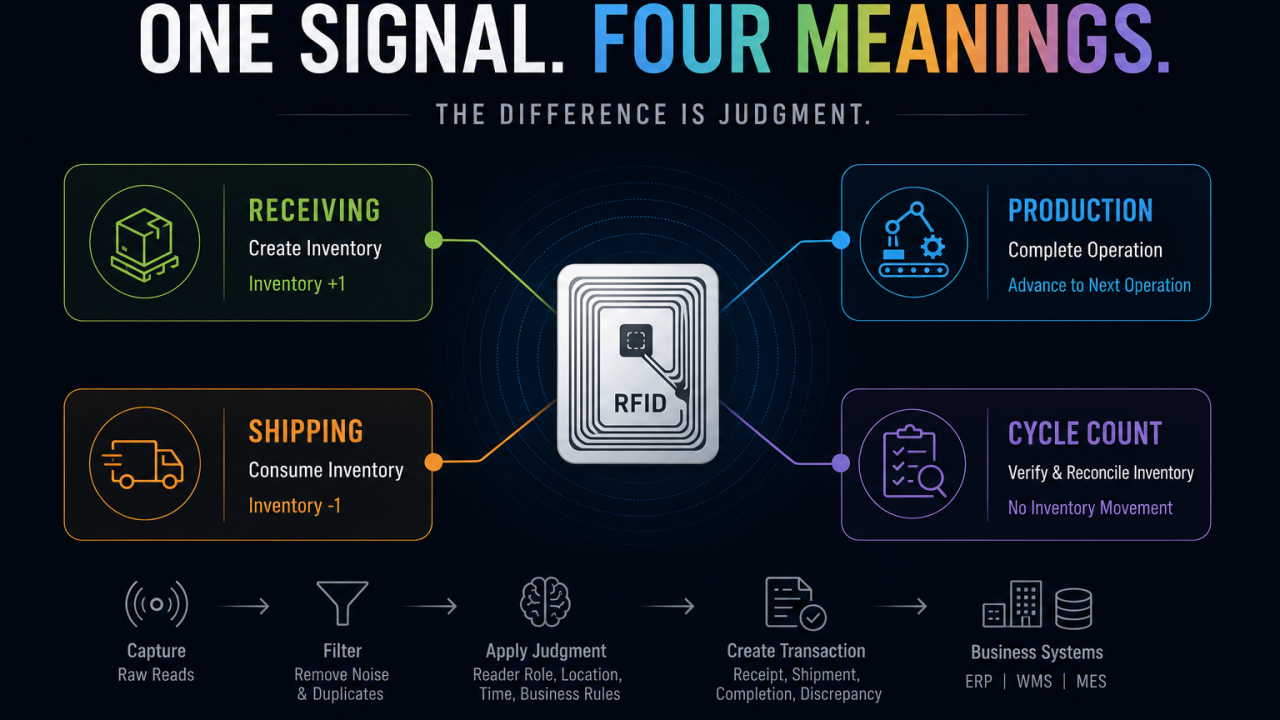
- A receiving operator knew that when they scanned a pallet, inventory should increase.
- A shipping operator scanned something that looked almost identical, but their scan meant inventory should decrease.
- A production operator scanned a job because they knew the work had been completed and it was ready to move to the next stage of production.
- A cycle count associate scanned the same barcode, yet that scan wasn't supposed to move inventory at all. It was simply checking whether reality matched the system.
The barcode never changed. The meaning came from the person holding the scanner.
That's the part many sensor deployments miss.
An RFID reader has no idea whether a tag passing by means something was received, shipped, completed on a production line, moved into the next work center, temporarily staged, or simply driven past on a forklift. The radio signal looks the same.
The intelligence isn't in the signal.
It's in the context.
That's why every reader in Xemelgo has a job description.
A receiving reader's job is to create inventory.
A shipping reader's job is to consume inventory.
A production reader's job is to recognize that work has been completed and advance the job to its next manufacturing step.
A cycle count reader's job is to verify reality and reconcile the inventory
The exact same EPC can pass four different readers and legitimately produce four completely different business transactions. Also the same reader can also have multiple jobs - one to close out inventory and mark the item as shipped at the same time.
The reader isn't just collecting data.
It's performing a role.
Once you start thinking this way, another realization follows.
The hard problem isn't collecting RFID reads.
Modern readers are remarkably good at that.
The hard problem is deciding which reads matter.
Real environments generate duplicate reads, reflections, phantom reads, tags sitting on forklifts, tags briefly passing through a doorway, and thousands of events that should never become business transactions.
Somewhere, software has to decide:
"Was that read real?"
"Should it create a transaction?"
"Which business process owns it?"
Only after those questions are answered does a sensor event become something an ERP, MES, or WMS actually understands.
This is also where many deployments quietly become difficult.
Building a demo with one reader and a few tags is relatively straightforward.
Running thousands of readers across dozens of warehouses and factories—with different layouts, different workflows, different hardware vendors, and millions of reads every day—while ensuring every transaction is interpreted consistently is an entirely different engineering problem.
If the transaction isn't right, inventory accuracy suffers. Production visibility suffers. Orders are delayed. Dashboards become suspect. Before long, people stop trusting the automation and start verifying everything manually.
That's why I believe the next frontier in Physical AI isn't about deploying more sensors.
It's about digitizing judgment.
Every technology revolution starts by digitizing information.
The companies that create lasting platforms figure out how to digitize judgment.
Warehouses and factories don't run because RFID readers detect tags.
They run because experienced operators make thousands of small decisions every day. They instinctively know what a scan means, when to ignore it, when inventory should be received, when an order has shipped, when a manufacturing operation is complete, and when something doesn't look right.
The real challenge for Physical AI isn't connecting sensors to the cloud. It's teaching software to make those same decisions consistently, millions of times a day, across thousands of sensors, warehouses, and factories, without someone quietly fixing exceptions behind the scenes.
That's not a sensor problem.
It's a judgment problem.
And I think that's where the next generation of enterprise software will be built—not by digitizing more data, but by digitizing the operational judgment that businesses have spent decades developing.